Camping Lantern Guide: Choose the Best One for Every Trip
Learn how to choose the best camping lantern — LED vs fuel vs solar, lumens by use case, battery types compared, and top picks for every campin.
When the sun drops at camp, a good lantern changes everything. Cooking dinner, playing cards at the picnic table, finding your way to the bathroom, reading in your tent — all of it depends on having reliable light.
The camping lantern market is crowded with options: LED, rechargeable, solar, propane, and candle-powered models span from $10 to $200+. Google Trends data shows “camping lantern” peaks at 100 in mid-April and stays strong through summer, making it one of the highest-demand camping gear topics season after season.
Most campers grab the cheapest lantern on Amazon and regret it — too dim for the campsite, breaks after one trip, batteries die halfway through the night, or leaks when it rains. This guide breaks down four main types of camp lanterns, how many lumens you actually need, battery vs rechargeable vs fuel tradeoffs, waterproof ratings explained, and seven specific product recommendations across every budget and camping style.
Types of Camping Lanterns
Four main types dominate the market, each built for different camping situations:
| Type | How It Works | Best For | Price Range |
|---|---|---|---|
| LED (battery) | LEDs powered by AA/AAA/D batteries | Reliable backup, cold weather | $10–$40 |
| LED (rechargeable) | LEDs powered by built-in Li-ion, USB charging | Car camping, convenience | $15–$80 |
| Fuel (propane/white gas) | Incandescent mantle heated by gas flame | Cold weather, large groups, classic ambiance | $30–$100 |
| Solar | LEDs powered by built-in solar panel + battery | Emergency backup, backpacking, eco-trips | $15–$50 |
Lumen (lm) — A measure of total light output. Higher means brighter. For reference, a single candle produces roughly 12 lumens, while a standard 60W household bulb outputs about 800 lumens.
IPX rating — The Ingress Protection scale for water resistance. IPX4 handles splashes, IPX7 survives submersion to 1 meter for 30 minutes, IPX8 goes beyond 1 meter.
Runtime — How long a lantern lasts on a single charge, set of batteries, or fuel canister at a given brightness level.
Mantle — The fabric mesh inside fuel lanterns that glows bright white when heated by the gas flame. Mantles are fragile and need periodic replacement.
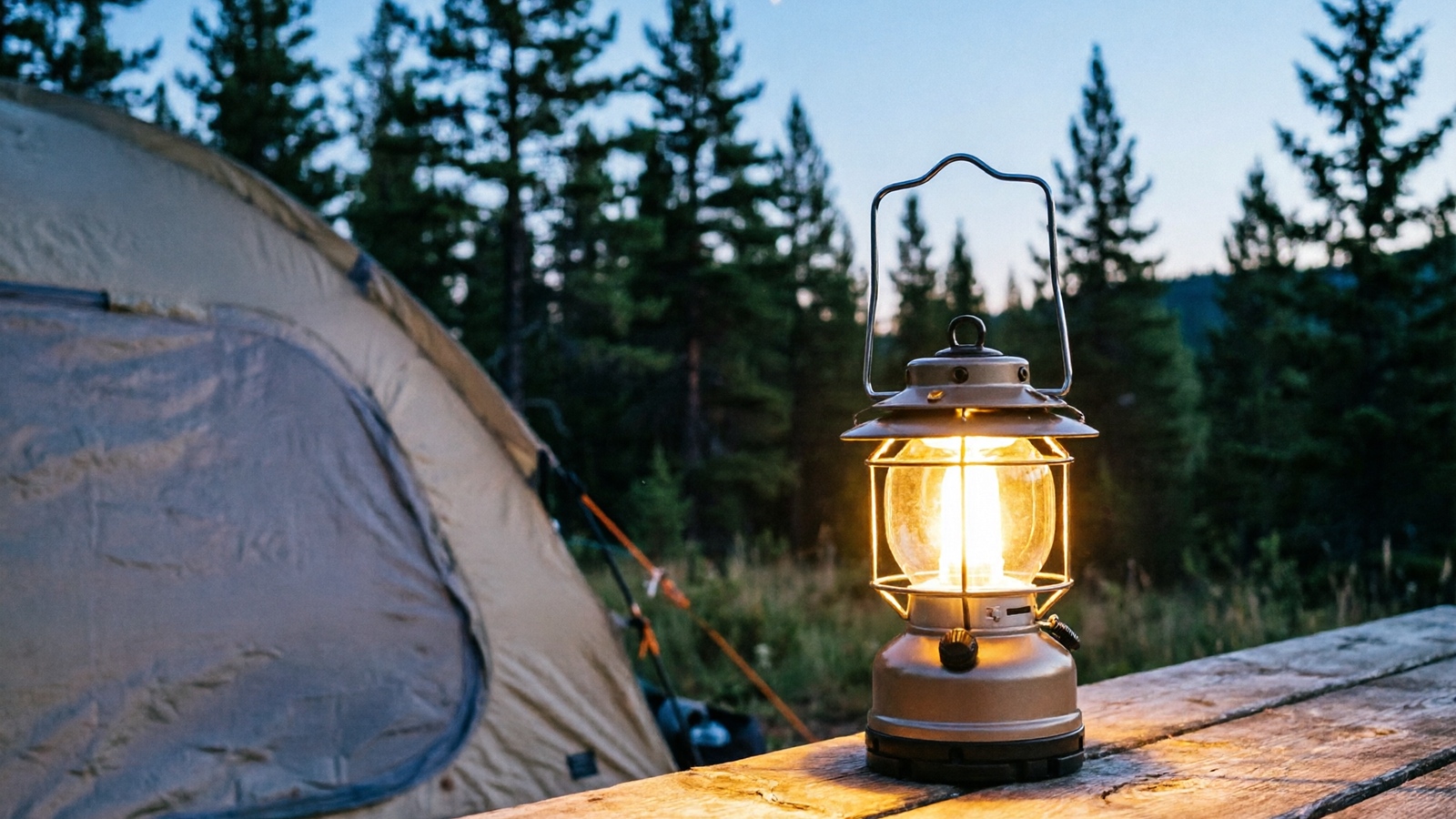
An LED camping lantern is the most popular choice today — lightweight, safe, and bright enough for most campers. A rechargeable camping lantern with USB charging has largely replaced battery-only designs for car camping convenience.
Fuel lanterns remain the go-to for cold-weather hunters and campers who want that warm, classic glow. A camping lantern fuel option like propane in particular outperforms every battery option when temperatures drop below freezing. Solar lanterns fill a niche for backpackers and emergency kits where charging access is limited.
How Bright? Understanding Lumens for Camping
Lumens tell you how much total light a lantern produces. But raw numbers mean little without context — a 1000-lumen lantern blazing inside a two-person tent is miserable. Here is how to match brightness to your actual needs:
| Use Case | Recommended Lumens | Notes |
|---|---|---|
| Inside tent (reading, changing) | 50–150 | Too bright feels harsh in a small space |
| Campsite cooking area | 200–400 | Must light food, stove, and prep surface |
| Picnic table / group area | 300–500 | Wide-area light for games and eating |
| Large group campsite | 500–1000 | Lights entire campsite perimeter |
| Emergency / power outage | 500–1000 | Max brightness, runtime matters less |
| Backpacking (tent only) | 30–100 | Weight matters more than brightness |
| Night hike / trail walking | Not recommended | Use a headlamp — lanterns lack focused beams |
Buy a lantern with adjustable brightness. One lantern on low (50 lumens, 30+ hour runtime) for the tent and on high (400 lumens, 6–8 hour runtime) for the campsite covers both needs.
Most quality lantern models include a dimmer switch or multiple brightness presets for exactly this reason. When comparing camping lantern lumen ratings, always check the runtime at each brightness level — higher lumens drain batteries faster.
Battery vs Rechargeable vs Fuel — Which Power Source?
Each power source has real tradeoffs. The right choice depends on where and when you camp — and camping lantern battery type affects weight, runtime, and cold-weather reliability:
| Factor | Disposable Battery (AA/D) | Rechargeable (USB/Li-ion) | Fuel (Propane/White Gas) |
|---|---|---|---|
| Convenience | Easy to swap, sold everywhere | USB charge at home, car, or power bank | Requires fuel canisters |
| Runtime (high) | 4–12 hours | 4–8 hours | 4–7 hours per canister |
| Runtime (low) | 20–50 hours | 15–40 hours | Single brightness setting |
| Cold Weather | Lithium AAs work to -40°F | Li-ion loses 20–40% below 20°F | Performs well in cold |
| Weight | Moderate (spare batteries add up) | Light (built-in battery) | Heavy (fuel + metal body) |
| Cost Over Time | Ongoing battery purchases | One-time purchase | Ongoing fuel purchases |
| Safety | Safe everywhere | Safe everywhere | CO risk, fire risk, no tents |
| Best For | Backup, cold weather, reliability | Car camping, backpacking | Large groups, cold, ambiance |
Most campers should own a camping lantern USB rechargeable LED model as their primary light, plus a small AA-battery LED as backup. Fuel lanterns serve enthusiasts who want the classic experience or need reliable cold-weather performance — if you regularly camp in winter, a propane lantern outperforms every battery option when temperatures drop below freezing.
Waterproof Ratings — What You Actually Need
Water resistance matters more than most campers expect. A camping lantern waterproof rating tells you exactly how much moisture it can handle. Rain happens. Morning dew soaks gear left on the picnic table. Condensation builds inside tents.
Accidental drops in streams and puddles are common near water-based campsites. Here is what each IPX rating means for camping:
- IPX0: No water protection. Indoor use only — skip this for camping.
- IPX4: Splash-resistant. Handles light rain and splashes from any direction. The minimum rating worth considering for any outdoor light.
- IPX6: Heavy rain resistant. Withstands water jets from any direction. A smart choice if you camp in areas with frequent rain.
- IPX7: Submersible to 1 meter for 30 minutes. Survives drops in puddles, streams, and boats. Ideal for kayak and canoe camping trips.
- IPX8: Submersible beyond 1 meter. Overkill for most camping, but useful for extended water-based expeditions.
For fair-weather car camping, IPX4 is sufficient. For anyone who regularly deals with wet conditions, aim for IPX6 or IPX7.
If your lantern has no IPX rating at all, store it in a dry bag when rain is in the forecast. For more wet-weather strategies, check our guide to camping in the rain.
Best Camping Lanterns for Car Camping
Car campers can afford some weight and bulk in exchange for brightness, runtime, and convenience. Here are three top picks:
LUXPRO Rechargeable LED Lantern (~$45) — The premium car camping pick. This USB rechargeable lantern pushes 940 lumens on high with a diffused lens for smooth, even lighting. The built-in power bank charges your phone in a pinch, and the dual-power design gives you flexible charging options.
With an IPX4 water-resistant rating, it handles campsite splashes without issue. Runtime reaches up to 155 hours on low.
Streamlight 44931 Siege (~$60) — The durability pick. Built with a tough polymer body that survives drops, the Siege outputs 540 lumens on high with 360-degree lighting. The rubberized base and grip provide secure handling in wet conditions.
A red LED mode preserves night vision, which is useful for astronomy camping or late-night bathroom trips. The compact design hangs easily from any branch or carabiner.
LED Camping Lantern 1000LM (~$16) — The value pick. This USB rechargeable model cranks out 1000 lumens on high with four light modes, charges via USB, and is fully waterproof for outdoor use. It also works as a power bank for your phone.
The compact build is easy to pack — not as rugged as the Streamlight — but at this price, it is hard to beat for casual car camping.
Best Camping Lanterns for Backpacking
Every ounce counts when you carry your home on your back. Backpacking lanterns prioritize weight and packed size over raw brightness.
BLACK DIAMOND Moji Lantern (~$30) — The ultralight pick. At a compact size, the Moji is one of the lightest lantern options available. It outputs 200 lumens, which is plenty for tent interiors, and features a dimming switch with color-shifting modes for ambiance.
The dimming feature lets you run it low for extended runtime or crank it up to find gear quickly. IPX4 rated for basic splash protection.
Solar LED Camping Lantern (~$30) — The solar backup pick. This 1500-lumen lantern packs a 7500mAh power bank and an integrated solar panel for off-grid charging. Eight light modes cover everything from low ambient glow to full brightness.
The USB port provides backup charging when solar is not enough, making it a versatile choice for multi-day backpacking trips. Waterproof rated for outdoor use.
For basic gear knowledge on what else to pack, see our camping guide for beginners.
Best Budget Camping Lanterns Under $30
You do not need to spend much to get a functional camp light. Here are two solid options under $30:
LED Camping Lantern 1000LM (~$16) — Already covered above, but worth repeating in the budget section. At $16, this is the best dollar-to-lumen ratio on the market. It charges via USB, outputs 1000 lumens max, and is waterproof.
The compact build will not last forever, but for occasional weekend trips, it gets the job done.
UCO Original Candle Lantern (~$38) — For campers who want simplicity, this candle-powered lantern runs on standard tealight or chandelier candles. It includes a long-burning emergency candle. Each candle produces a warm glow perfect for atmosphere. The spring-loaded candle tube keeps the flame at a consistent height as the candle melts.
With a collapsible aluminum body, it is lightweight and nearly indestructible. It also generates a small amount of warmth inside a cold tent — a nice bonus. No batteries, no charging, no electronics to fail.
Budget buying tip: avoid no-name brands claiming “10,000 lumens” for under $10. Those numbers are inflated and the build quality rarely survives a single trip. Stick with recognizable brands in the $15–$30 range for a lantern that actually holds up.
Coleman Lanterns — The Classic Choice
Coleman is the most searched lantern brand on Google Trends — a Coleman camping lantern peaks at 100 in April during prime camping season. The brand has earned that attention through decades of reliable fuel and LED lanterns.
Coleman Quad Pro 800L LED Lantern (~$52) — The family camping pick. This rugged lantern outputs 800 lumens for bright, reliable campsite lighting. The Quad Pro builds on Coleman’s decades of lantern expertise with lifetime LEDs that never need replacing.
For family car camping where reliable, bright lighting matters, the Quad Pro delivers consistent performance that Coleman is known for.
Why a Coleman fuel lantern might appeal to you: Fuel lanterns produce a warm, golden light that LEDs cannot replicate. The ambiance around a lit propane lantern on a cold evening, paired with a crackling fire, is the quintessential camping experience.
Fuel lanterns also produce heat, which can take the chill off a tent vestibule or enclosed shelter. For more on building that classic campfire atmosphere, see our guide on how to build a campfire.
Tradeoffs of fuel lanterns: Glass mantles break easily and need spares. Fuel lanterns must never be used inside tents due to carbon monoxide risk.
They are heavy compared to LED options, and fuel canisters are bulky to pack.
Solar Camping Lanterns — When to Consider One
Solar lanterns serve a specific niche. They are not bright enough for primary campsite lighting, but they excel as backup and emergency lights.
When solar makes sense: Multi-day backpacking trips with no power access, kayak camping where weight and waterproofing matter, home emergency kits for power outages, and eco-conscious camping where you want zero battery waste.
The solar camping lantern category has grown steadily — Google Trends shows “solar camping lantern” rising in related queries over the past year.
Limitations to know: Solar charging requires 6–10 hours of direct sunlight for a full charge. Cloudy days mean partial charges and reduced runtime.
Most solar lanterns max out at 100 lumens — fine for tent interiors but inadequate for cooking areas. Runtime typically runs 6–12 hours on a full charge at low brightness.
The Solar LED Camping Lantern (covered in the backpacking section) is the best solar option because it has USB backup charging and a 7500mAh power bank. When solar fails, plug it into a power bank for a full recharge.
This hybrid approach removes the main drawback of solar-only lanterns.
How to Hang and Position Your Camping Lantern
Placement makes a huge difference in how useful your lantern is. Here is how to get the most from each light:
-
Tent interior: Hang from the ceiling loop or gear loft using the built-in hook or carabiner. Position it in the center for even light distribution. Use the lowest brightness setting — 50 lumens is plenty inside a tent, and higher settings create harsh glare on tent walls.
-
Campsite cooking area: Hang from a tripod, tree branch, or tarp ridgeline at 5–6 feet high, positioned behind and slightly above your cooking surface. This lights your workspace without casting shadows from your body onto the food.
-
Picnic table: Set it flat on the table on low-to-medium, or hang from a nearby branch at 4–5 feet. A lantern with a frosted diffuser produces softer light than bare LEDs, which create harsh shadows on flat surfaces.
-
Path and walkway lighting: Place two or three small lanterns along the path from tent to bathroom at ground level on low. This marks the route without killing your night vision.
-
Full car camping setup: Use one bright lantern (400+ lumens) for the main campsite area plus one small lantern (50–100 lumens) inside each tent. This two-lantern system covers every situation.
Hanging tips: Most lanterns have a built-in hook — if yours does not, a small S-biner carabiner ($3) solves the problem instantly. A 2-foot loop of paracord lets you hang a lantern from branches at any height.
Magnet-base lanterns stick to car hoods, tent poles, and metal camp tables.
Camping Lantern Safety Tips
- Never use fuel lanterns inside tents, vehicles, or enclosed spaces — carbon monoxide kills. Fuel lanterns are outdoor-only with ventilation.
- Keep fuel lanterns away from flammable materials — mantles reach 1,000°F+ and the glass gets extremely hot. Clear a 3-foot radius.
- Carry a spare light source — if your primary lantern dies (dead battery, broken mantle), a headlamp is your backup. Always pack one.
- Store batteries separately for air travel — TSA requires spare batteries in carry-on luggage, not checked bags. Li-ion batteries over 100Wh are restricted on flights.
- Charge rechargeable lanterns before every trip — Li-ion batteries self-discharge at roughly 2% per month. A lantern charged three months ago may be at 50% capacity.
- Replace fuel lantern mantles before they shred — a torn mantle produces uneven light and can damage the lantern glass. Carry 2–3 spare mantles on any trip with a fuel lantern.
- Do not stare directly at high-lumen lanterns — 500+ lumen LEDs can temporarily impair night vision. Use diffusers or frosted covers to soften the light.
For a complete guide to staying safe outdoors, see our camping safety tips guide.
Camping Lantern Comparison Table
Here is how all seven recommended lanterns stack up:
| Lantern | Type | Lumens | Runtime | IPX | Weight | Price | Best For |
|---|---|---|---|---|---|---|---|
| LUXPRO Rechargeable LED Lantern | USB rechargeable | 940 | Up to 155 hrs (low) | IPX4 | — | ~$45 | Car camping premium |
| LED Camping Lantern 1000LM | USB rechargeable | 1000 | 4 light modes | Waterproof | — | ~$16 | Budget / best value |
| Streamlight 44931 Siege | LED (battery) | 540 | Multi-mode | — | Compact | ~$60 | Durability / rain |
| BLACK DIAMOND Moji Lantern | AAA battery | 200 | Dimmable | IPX4 | Compact | ~$30 | Backpacking ultralight |
| Coleman Quad Pro 800L | LED | 800 | Lifetime LEDs | — | Rugged | ~$52 | Family camping |
| UCO Original Candle Lantern | Candle | — | Per candle | — | — | ~$38 | Simplicity / warmth |
| Solar LED Camping Lantern | Solar + USB | 1500 | 8 light modes | Waterproof | — | ~$30 | Solar / emergency |
Prices are approximate and may vary on Amazon.
Related gear reviews: Best Camping Lantern · 10 Best Camping Headlamps
Camping Lantern FAQ
How many lumens do you need for a camping lantern?
50–150 lumens for the tent, 200–400 for cooking, and 500+ for large group campsites. A lantern with adjustable brightness lets one light handle all three situations.
Are rechargeable lanterns better than battery-powered ones?
For car camping, yes — USB rechargeable models are more convenient and cheaper over time. For cold weather below 20°F or trips longer than the lantern’s runtime, disposable lithium AA batteries are more reliable than built-in Li-ion packs.
Can you use a camping lantern inside a tent?
LED lanterns are safe inside tents — no heat, no fumes, no fire risk. Fuel lanterns (propane, butane, white gas) must never go inside a tent due to carbon monoxide danger.
What is the best camping lantern for the money?
The LED Camping Lantern 1000LM (~$16) for budget, the LUXPRO Rechargeable LED Lantern ($45) for quality, and the Coleman Quad Pro 800L ($52) for families who need reliable, bright lighting.
Do I need a waterproof camping lantern?
IPX4 minimum if rain is possible on your trips. IPX6–IPX7 for consistent wet conditions or water-based camping. Most quality LED lanterns include at least IPX4.
How long do camping lantern batteries last?
LED lanterns: 4–50 hours depending on brightness setting. Fuel lanterns: 4–7 hours per propane canister on high. Solar: 6–12 hours per full charge. Always carry a backup headlamp on any trip longer than one night.
What is the difference between a camping lantern and a headlamp?
A camping lantern produces 360-degree ambient light for an entire area — ideal for cooking, eating, and socializing. A headlamp provides a focused beam for your field of vision — better for hiking and hands-free tasks. Most campers need both.
A reliable camp light is essential gear, not an afterthought. Most campers are best served by a USB rechargeable LED lantern — the LUXPRO for quality, the LED Camping Lantern 1000LM for budget — plus a headlamp as backup.
For families, the Coleman Quad Pro 800L delivers reliable brightness. For backpackers, the BLACK DIAMOND Moji disappears in your pack until you need it. Pick the one that matches your camping style and stop fumbling in the dark.
Frequently Asked Questions
How many lumens do you need for a camping lantern?
For tent use, 50–150 lumens is plenty — enough to read, change clothes, and find gear without blinding yourself. For a campsite cooking area, 200–400 lumens lights a 10-foot radius. For large group campsites, 500–1000 lumens covers a wide area. Most campers do best with a lantern that has adjustable brightness so one light works for both tent and campsite.
Are rechargeable lanterns better than battery-powered ones?
For car camping, yes — USB rechargeable lanterns are more convenient and cheaper long-term since you stop buying AA batteries. For backpacking, it depends on trip length. A rechargeable lantern with built-in Li-ion battery is lighter than carrying spare AAs, but on trips longer than its runtime, disposable batteries win. For cold-weather camping below 20°F, disposable lithium AA batteries outperform Li-ion, which loses capacity in the cold.
Can you use a camping lantern inside a tent?
LED lanterns are completely safe inside a tent — no heat, no carbon monoxide, no open flame. Fuel-powered lanterns (propane, butane, white gas) must NEVER be used inside a tent. They produce carbon monoxide and the hot mantles or glass are a serious fire hazard. Use a sleeping bag rated for the temperature if you need warmth inside.
What is the best camping lantern for the money?
The LED Camping Lantern 1000LM (~$16) is the best value — USB rechargeable, 1000 lumens max, waterproof, and doubles as a power bank. For quality and durability, the LUXPRO Rechargeable LED Lantern ($45) offers 940 lumens, USB charging, and a built-in power bank. For the classic camping experience, the Coleman Quad Pro 800L LED Lantern ($52) gives you 800 lumens of reliable family lighting.
Do I need a waterproof camping lantern?
If you camp in rain-prone areas or near water, look for IPX4 minimum — that handles splashes and light rain. IPX6 handles heavy rain and IPX7 survives submersion to 1 meter. For fair-weather car camping, water resistance is less critical, but most quality lanterns handle light moisture. Always store any lantern in a dry bag during heavy rain.
How long do camping lantern batteries last?
LED lanterns run 5–50 hours depending on brightness setting. A 300-lumen lantern on low (~50 lumens) typically lasts 20–30 hours. On max brightness, expect 4–8 hours. Fuel lanterns burn through a 16.4 oz propane canister in 4–7 hours on high. Solar lanterns give 6–12 hours per full solar charge but need 6–10 hours of direct sun to recharge. Always pack a backup headlamp.
What is the difference between a camping lantern and a headlamp?
A camping lantern produces 360-degree ambient light that illuminates an entire area — ideal for cooking, eating, and socializing at camp. A headlamp provides a focused directional beam on your forehead — better for hiking, trail walking, and hands-free tasks in the dark. Most experienced campers carry both: a headlamp for personal navigation and a lantern for shared campsite lighting.