Pet-Friendly Camping: Find the Best Campsites & Prep
How to find and prepare for pet-friendly camping — campground research, pet policies, packing lists, and safety tips for camping with dogs.
What Does “Pet-Friendly” Actually Mean?
“Pet-friendly” means different things at different campsites. Before you book, understand what you’re actually getting:
Level 1 — Minimum: Dogs allowed in the campground on leash. No additional amenities.
Level 2 — Standard: Dogs allowed + designated dog areas (fenced run, dog park on-site).
Level 3 — Premium: Dog wash station, off-leash areas, dog treats at check-in, nearby dog-friendly trails.
Most campgrounds are Level 1 or 2. Don’t assume — always verify.
How to Research Pet-Friendly Campsites
Best Booking Platforms
| Platform | Pet Filter | User Pet Reviews | Best For |
|---|---|---|---|
| Recreation.gov | ✅ Yes | ⚠️ Limited | National parks, federal campgrounds |
| Hipcamp | ✅ Yes | ✅ Yes | Private land, unique stays |
| KOA.com | ✅ All locations | ✅ Yes | Family-friendly, consistent quality |
| Campendium | ✅ Yes | ✅ Detailed | RV parks, BLM land, comprehensive database |
| Reserve America | ✅ Yes | ⚠️ Limited | State park campgrounds |
Red Flags to Watch For
When reading campground descriptions and reviews, watch for these:
- 🚩 “Pets must be attended at all times” — means you can’t leave your dog at the campsite while you hike
- 🚩 “Breed restrictions apply” — often targets pit bulls, rottweilers, dobermans, and mixes
- 🚩 “Maximum 2 pets per site” — if you have 3 dogs, look elsewhere
- 🚩 “No pets on beach/swimming area” — limits your dog’s access
- 🚩 “Pet fee applies” — $10-30/night adds up on a week-long trip
Green Flags
- ✅ “Fenced dog run on-site” — your dog can burn energy off-leash safely
- ✅ “Dog wash station” — clean your pup before the car ride home
- ✅ “Nearby off-leash trails” — research trail rules independently
- ✅ “Dog beds/treats provided” — premium pet-friendly experience
- ✅ Recent reviews mentioning dogs: “Our golden retriever loved it here!”
Reservation Tips for Pet Owners
-
Book early: Pet-friendly sites fill up faster than regular sites — especially holiday weekends and summer months. Book 3-6 months ahead for popular destinations.
-
Call, don’t just click: Online booking systems don’t always show current pet policies or fees. A 2-minute phone call can save you from arriving with your dog and being turned away.
-
Ask about nearby vet clinics: Get the address and phone number of the nearest emergency vet before you arrive.
-
Request a site away from the road: Quieter sites reduce the chance your dog will bark at passing cars and hikers.
-
Check seasonal restrictions: Some campgrounds allow dogs in summer but not during hunting season (fall), or vice versa.
Preparing Your Pet for Camping
Health Preparation (2-4 Weeks Before)
- Vet checkup: Schedule a visit 2 weeks before your trip. Get health certificates if crossing state lines or entering Canada.
- Vaccinations: Ensure rabies, DHPP, Bordetella, and Lyme vaccines are current.
- Flea/tick/heartworm prevention: Apply or administer 1 week before departure.
- Microchip check: Verify your pet’s microchip is registered with your current phone number.
- Medication refill: Pack enough for the trip plus 5 extra days. Include anti-diarrhea medication (dogs often get upset stomachs from camp water or new food).
Training Preparation (1-2 Weeks Before)
- Leash manners: Your dog should walk calmly on leash without pulling. Practice around distractions.
- Recall command: Even on-leash dogs need reliable recall for emergencies.
- “Leave it” command: Critical for wildlife encounters, dropped food, and toxic plants.
- Crate training: If your dog isn’t crate-trained, practice before the trip. A crate provides a safe space in camp.
- Car ride tolerance: If your dog doesn’t ride well, practice short trips with positive reinforcement.
Gear Checklist
For Dogs
- Vaccination records (printed copy)
- Leash (6-foot) + tie-out cable (15-30 ft) — the XiaZ 50ft Dog Tie-Out Trolley sets up overhead in five minutes and gives your dog full roam at camp, rated for dogs up to 200 lbs. For a simpler setup, the Petbobi 30ft Tie-Out Cable and Stake combines a heavy-duty cable with a 16-inch ground stake.
- Collapsible food and water bowls
- Food (25% extra) and treats
- Poop bags (100+ — seriously, you’ll use them)
- First-aid kit (tick remover, paw bandages, antiseptic, tweezers)
- Sleeping pad or blanket
- Towels (2-3)
- Dog-safe sunscreen and bug spray
- ID tag with cell number
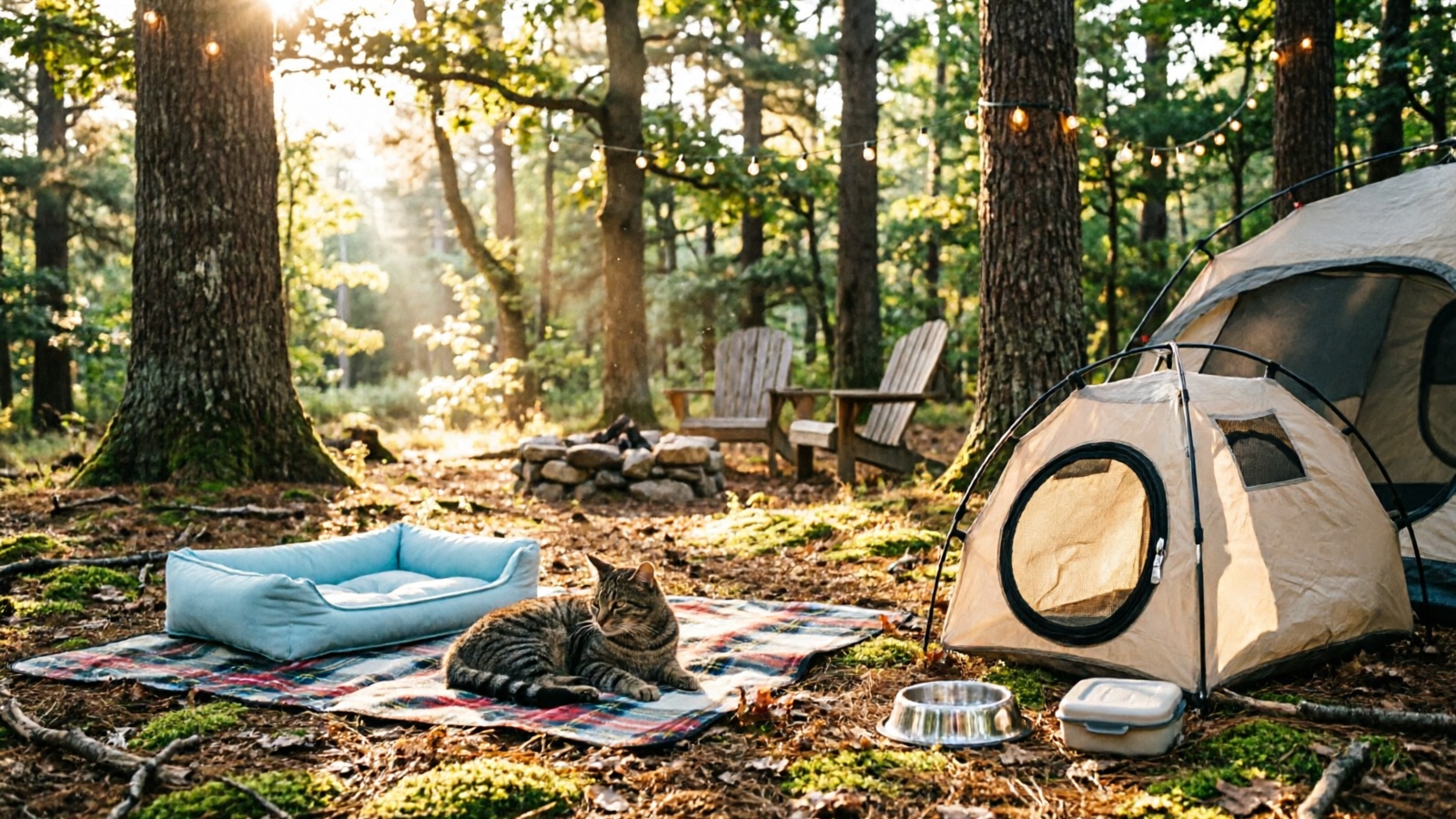
For Cats
- Harness and leash (escape-proof)
- Carrier or travel crate
- Litter box + litter (compact travel version)
- Food, water, and treats
- Familiar bedding (smell of home reduces stress)
- Enclosed tent or pop-up shelter for safe outdoor time
Handling Common Problems
My Dog Won’t Stop Barking
This is the most common complaint from fellow campers. Solutions in order of effectiveness:
-
Exercise more — a tired dog doesn’t bark. Hike for 1-2 hours before quiet hours.
-
Frozen Kong — stuff with peanut butter and freeze. Lasts 1-2 hours.
-
White noise — a small fan or white noise app masks triggering sounds.
-
Calming aids — Adaptil collar, Thundershirt, or vet-prescribed calming medication for severely anxious dogs.
-
Leave if necessary — if your dog is genuinely distressed, they’re not having fun. Try again another time.
A reliable tie-out is essential for keeping your dog safe and close at camp. The Tresbro 50ft Dog Trolley System is lightweight and reflective, rated for dogs up to 300 lbs with quick-setup hardware.
Wildlife Encounters
- Skunks: Keep your dog on leash at dusk and dawn. If sprayed, use deskunking shampoo (1 quart 3% hydrogen peroxide + 1/4 cup baking soda + 1 tsp dish soap). Tomato juice is a myth.
- Porcupines: If your dog gets quilled, don’t try to pull them out yourself — quills break easily and fragments cause infection. Go to the vet immediately.
- Snakes: Keep your dog on trail and away from rocks and brush piles. If bitten, carry your dog to the car and drive to the nearest vet. Time is critical.
- Bears: Store ALL food (including dog food) in bear canisters or locked cars. Use a bear hang if backcountry camping. Keep your dog close and calm.
My Dog Got Sick
Common camping illnesses and what to do:
| Symptom | Likely Cause | Action |
|---|---|---|
| Vomiting/diarrhea | Drank stream water, ate something on trail | Switch to bottled water, bland diet (rice + boiled chicken), monitor 24 hours |
| Limping | Paw cut, thorn, or sprain | Check paws carefully, remove foreign objects, rest 24 hours |
| Excessive scratching | Ticks, fleas, or allergic reaction | Full body tick check, apply flea treatment, benadryl (1mg per lb of dog weight) |
| Lethargy/dehydration | Heat stroke, overexertion | Move to shade, offer small amounts of water, wet their belly and paws. Go to vet if no improvement in 30 minutes |
Pet-Friendly National Parks
Some of the best national parks for dogs:
| Park | Dog Policy | Best Trails for Dogs |
|---|---|---|
| Acadia (ME) | ✅ Most trails allow leashed dogs | carriage roads (gravel, easy), Acadia National Park Loop |
| Shenandoah (VA) | ✅ Most trails allow leashed dogs | Limberlost Trail (accessible), Dark Hollow Falls |
| Great Smoky Mountains (TN/NC) | ⚠️ Dogs on 2 trails only (Gatlinburg Trail, Oconaluftee River Trail) | Very limited — consider nearby national forest instead |
| Yosemite (CA) | ⚠️ Leashed on paved trails, roads, campgrounds only | Yosemite Valley loop, Mirror Lake Trail (paved section) |
| Grand Canyon (AZ) | ⚠️ Leashed on rim trails (South Rim only) | Rim Trail, Greenway Trail |
| Joshua Tree (CA) | ✅ All trails allow leashed dogs | All park trails — one of the most dog-friendly national parks |
Related gear reviews: 8 Best Camping Tents · 9 Best Camping Sleeping Pads
Conclusion
For dog-specific tips, see our camping with dogs guide and beginner camping guide.
Camping with your pet is incredibly rewarding when done right. The key is preparation: research your campsite, pack the right gear, train basic commands, and always have a backup plan. Start with short, easy trips and build up to bigger adventures.
Your dog doesn’t need to be a wilderness expert — they just need you to be prepared. Happy camping!
This guide contains affiliate links. If you purchase through these links, we may earn a small commission at no extra cost to you.
Frequently Asked Questions
How do I find pet-friendly campsites?
Use Recreation.gov (filter by 'Pets Allowed'), Hipcamp (has a dedicated pet filter), KOA.com (all locations are pet-friendly), and Campendium (user reviews often mention pet experiences). Always call the campground directly to confirm current pet policies — websites may be outdated.
Do campgrounds charge extra for pets?
Many do. KOA charges $10-25/night per pet. State parks typically charge $5-10/night. National park campgrounds usually don't charge extra but have strict leash rules. Private campgrounds vary widely — some charge nothing, others up to $30/night.
Can I bring my cat camping?
It's possible but requires extra preparation. Cats should always be kept on a harness and leash or in a secure carrier/tent. Many campgrounds that allow dogs also allow cats, but check ahead. Cats are more likely to bolt when startled, so a harness-trained cat is essential. Consider an enclosed pop-up tent as a safe outdoor space.
What vaccinations does my dog need for camping?
Rabies (legally required in all 50 states), DHPP (distemper, hepatitis, parainfluenza, parvovirus), Bordetella (kennel cough — camping often means dog-to-dog contact), and Lyme vaccine (if camping in tick-heavy areas like the Northeast or Upper Midwest). Bring vaccination records — some campgrounds require proof.