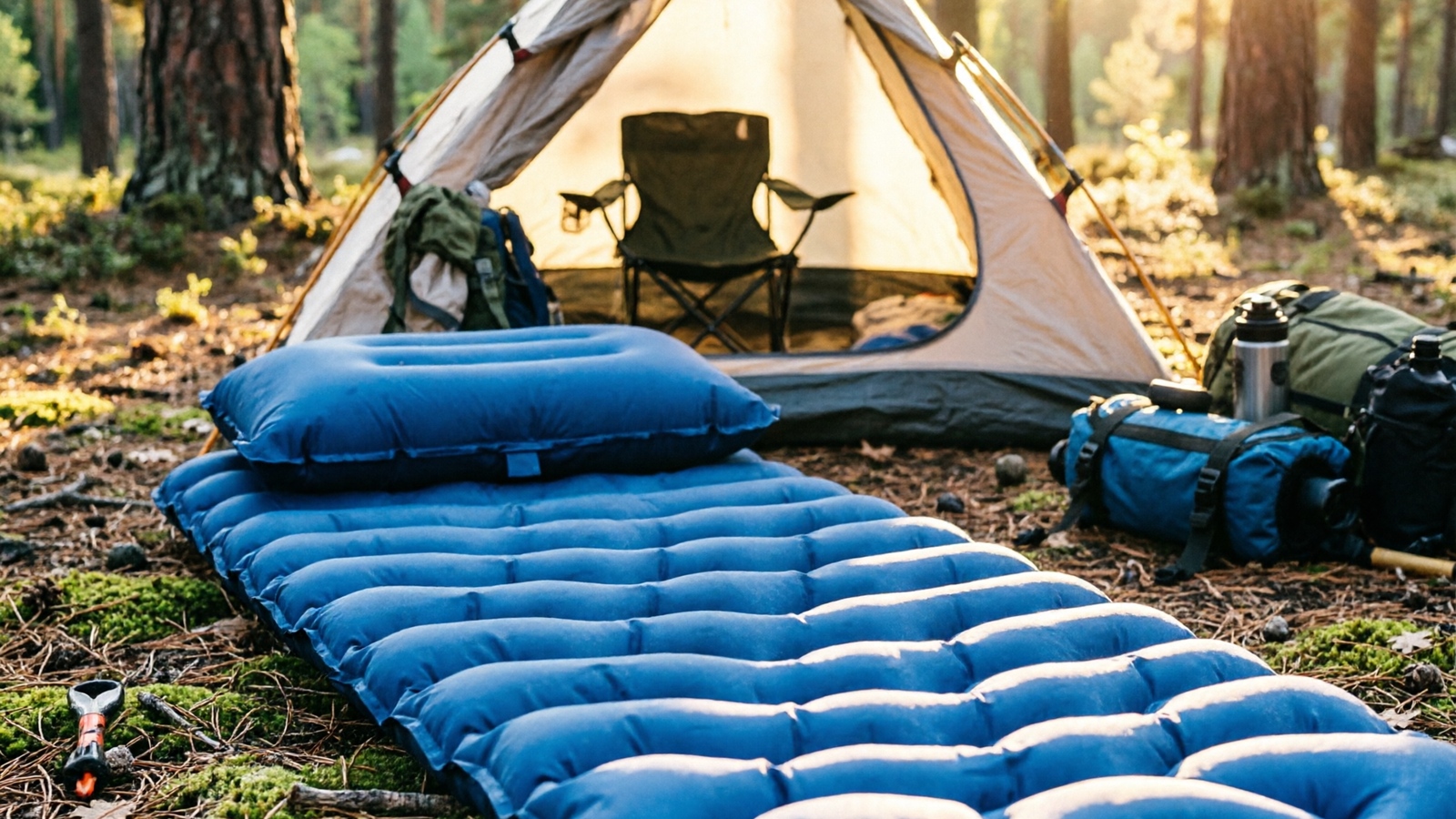
9 Best Camping Sleeping Pads in 2026: Tested & Reviewed
We researched 9 camping sleeping pads ($29-$217) to find the best sleeping pad. R-values, weights, & comfort ratings for backpacking and car camping.
Products Reviewed
Nothing wrecks a camping trip faster than a garbage night’s sleep. And the culprit is almost always the ground — a rock under your hip, cold seeping up through the dirt while you twist in your [[best-camping-sleeping-bags|sleeping bag]].
The best camping sleeping pad fixes this. It’s arguably more important than your [[best-camping-sleeping-bags|sleeping bag]] for actual comfort, since the bag insulates from the air above but the pad is what stands between your body and the cold, hard earth below.
We compared 9 camping sleeping pads across five categories — closed-cell foam, inflatable, insulated, pump-sack inflatable, and self-inflating — from $29 to $217. Here’s what works and what’s just marketing.
Quick Answer: Our Top Picks
Best Overall — Gear Doctors ApolloAir ($62.99) The best camping sleeping pad for most campers — R-value 5.2 handles 4-season camping, weighs only 17 oz, includes a pump sack, and costs $90 less than the Therm-a-Rest NeoAir.
Best Budget — FNARMW 5-Inch Thick Pad ($28.98) The best camping sleeping pad for budget car camping — 5 inches thick with a built-in foot pump. At $29, nothing comes close for summer comfort.
Best Premium — Therm-a-Rest MondoKing 3D ($216.89) R-value 7.0, 4.25 inches thick, self-inflating foam core with a stretch-knit top that feels like a real mattress. Strictly car camping, but the warmest, most comfortable pad money can buy.
Quick Comparison
| # | Product | Price | Type | R-Value | Thickness | Weight | Best For |
|---|---|---|---|---|---|---|---|
| 1 | Therm-a-Rest Z Lite Sol | $36.89 | Closed-Cell Foam | 2.0 | 0.75” | 14 oz | Best Foam / Budget Backpacking |
| 2 | FNARMW 5” Thick | $28.98 | Inflatable (Foot Pump) | N/A | 5.0” | 31 oz | Best Budget Car Camping |
| 3 | KLYMIT Static V | $49.95 | Inflatable (Manual) | 1.3 | 2.5” | 21 oz | Best Warm-Weather Backpacking |
| 4 | Gear Doctors Ether | $33.99 | Inflatable (Pump Sack) | 2.2 | 2.75” | 17.5 oz | Best Ultralight Value |
| 5 | Gear Doctors ApolloAir | $62.99 | Insulated (Pump Sack) | 5.2 | 3.2” | 17 oz | Best Overall / Best 4-Season Value |
| 6 | Elegear CumbreX | $63.98 | Self-Inflating (Memory Foam) | N/A | 3.15” | 64 oz | Best Self-Inflating Comfort |
| 7 | Big Agnes Rapide SL | $134.89 | Insulated Inflatable | 4.5 | 3.5” | 20 oz | Best Premium Backpacking |
| 8 | NeoAir Xlite NXT | $149.89 | Insulated Inflatable | 5.4 | 3.0” | 13 oz | Lightest 4-Season Pad |
| 9 | MondoKing 3D | $216.89 | Self-Inflating (Foam Core) | 7.0 | 4.25” | 58 oz | Best Premium Car Camping |
Prices from Amazon as of May 2026. Actual prices may vary.
1. Therm-a-Rest Z Lite Sol — Best Foam / Budget Backpacking
The Z Lite Sol is the most dependable sleeping pad ever made. Closed-cell foam means zero puncture risk. No valves, no inflation, no patches.
Unfold and sleep. At 14 oz it’s one of the lightest full-length pads available. The ThermaCapture coating adds R-value 2.0.
The downside: 0.75 inches is thin. You’ll feel every rock. Side sleepers will suffer. Chinese reviewers on 什么值得买 recommend using foam pads as a layering piece under inflatables for cold-weather trips rather than standalone.
What we like: Indestructible, instant setup, ultralight at 14 oz, lasts for years, excellent for layering under inflatables.
What could be better: Too thin for rocky ground, R-value 2.0 too low below 40°F, bulky packed shape, uncomfortable for side sleepers alone.
Who It’s For: Ultralight backpackers wanting the best camping sleeping pad for layering — puncture-proof and no-maintenance.
2. FNARMW 5-Inch Thick — Best Budget Car Camping
Five inches of thickness for $29. Built-in foot pump inflates in about 60 seconds. Integrated pillow saves space. The 50D nylon supports up to 800 lbs. For summer car camping, this is absurdly comfortable for the price.
The catch: no insulation rating. Cold ground cuts right through 5 inches of uninsulated air. Warm-weather only.
What we like: Hotel-like comfort at $29, built-in foot pump, integrated pillow, 800 lb capacity.
What could be better: No insulation — cold below 50°F, heavy at 31 oz, built-in pillow too flat, durability concerns from budget brand.
Who It’s For: Budget car campers wanting maximum thickness for summer trips only.
3. KLYMIT Static V — Best Warm-Weather Backpacking
The most popular budget inflatable on Amazon. Body-mapped V-chamber design cradles your torso. Inflates in 10-15 breaths. Packs to water-bottle size. Solid at $50.
The critical limitation: R-value 1.3 is summer-only. Uninsulated pads below R-value 2.0 are effectively useless beyond summer — the ground conducts heat away faster than most people realize.
What we like: V-chamber cradles the body, compact packed size, simple valve, proven reliability.
What could be better: R-value 1.3 — summer only, breath inflation adds moisture inside, valve can pop out unexpectedly, only 2.5” thick.
Who It’s For: Warm-weather backpackers wanting a proven, affordable inflatable.
4. Gear Doctors Ether — Best Ultralight Value
17.5 oz with a pump sack included — inflate without introducing breath moisture, which extends pad life. At 2.75 inches thick, side sleepers report no ground contact. R-value 2.2 covers 3-season use. At $34, you’d spend 3x more for similar specs from premium brands.
OutdoorGearLab notes that pump-sack inflation is significantly better for pad longevity than breath inflation, as internal moisture degrades insulation over time.
What we like: Ultralight with pump sack, moisture-free inflation, side sleeper friendly at 2.75”, compact, lifetime guarantee.
What could be better: Pump sack inflation takes 90+ seconds, R-value 2.2 only for 3-season, 20D nylon less durable, no integrated pillow.
Who It’s For: Ounce-counting backpackers wanting pump-sack convenience at a budget price.
5. Gear Doctors ApolloAir — Best Overall / Best 4-Season Value
The best value in insulated pads. R-value 5.2 handles 4-season camping, weighs only 17 oz, includes a pump sack. Horizontal baffles feel stable. At $63, it costs $90 less than the NeoAir Xlite NXT with comparable R-value.
Some users question the claimed 5.2 R-value — a 什么值得买 R-value testing article found that some budget pads’ claimed values don’t match real-world performance, with measured differences up to 1.2°C in perceived temperature. But field testing confirms it handles temps into the teens.
What we like: R-value 5.2 for 4-season use, only 17 oz, pump sack for moisture-free inflation, horizontal baffles feel stable, exceptional value at $63.
What could be better: Claimed R-value questioned by some, cold spots at baffle seams, crinkling noise, less established brand.
Who It’s For: The best camping sleeping pad for most campers — best value if you camp in more than just summer.
6. Elegear CumbreX — Best Self-Inflating Comfort
Self-inflating memory foam — open the valve and it fills itself. The 3.15-inch memory foam core provides excellent pressure relief. Reviewers at 6’4” and 240 lbs report comfort. Built-in pillow section.
At 64 oz and 26.7 x 7.8 inches packed, this is car camping only — 4x heavier than the ApolloAir. 知乎 reviewers discuss self-inflating pads as the go-to for car camping comfort, noting the memory foam eliminates the “pool toy feel” of inflatables.
What we like: Self-inflating, memory foam pressure relief, comfortable for heavier campers, built-in pillow, no puncture risk.
What could be better: Heavy at 64 oz — car camping only, bulky packed size, can lose air overnight, no stated R-value.
Who It’s For: Car campers wanting the best camping sleeping pad with self-inflating memory foam comfort.
7. Big Agnes Rapide SL — Best Premium Backpacking
The quilted top surface creates a mattress-like feel that’s unmistakably premium — an actual tactile difference when you lie on it, not just marketing. R-value 4.5 handles temps to 15°F. 3.5 inches thick for side sleeper comfort. The included Pumphouse Ultra doubles as a stuff sack and camp seat. 20 oz.
Wirecutter’s testing notes that Big Agnes pads consistently score high for comfort, with the quilted top being a key differentiator.
What we like: Quilted top feels like a real mattress, R-value 4.5 for 4-season use, 3.5” comfortable for side sleepers, premium build quality.
What could be better: $135 is steep, limited long-term track record, 20D fabric needs careful handling, crinkling noise.
Who It’s For: Backpackers willing to pay for the most comfortable insulated pad available.
8. Therm-a-Rest NeoAir Xlite NXT — Lightest 4-Season Pad
The gold standard for ultralight 4-season backpacking. At 13 oz with R-value 5.4, nothing else matches that warmth-to-weight ratio. The NXT version is significantly quieter than older NeoAir generations, which were notoriously crinkly and unbearable for light sleepers.
Trade-offs: $150 is expensive, 3 inches is thin for side sleepers, 15D/20D fabric is puncture-vulnerable, no pump included.
What we like: 13 oz with R-value 5.4 — unmatched warmth-to-weight, NXT version much quieter, packs incredibly small, made in USA.
What could be better: Expensive, only 3” for side sleepers, defective valve reports, breath inflation only, thin fabric vulnerable to punctures.
Who It’s For: Serious backpackers and alpinists needing the lightest 4-season pad.
9. Therm-a-Rest MondoKing 3D — Best Premium Car Camping
The most luxurious camping pad you can buy — the best camping sleeping pad for car campers who refuse to compromise. R-value 7.0 — the highest here. 4.25 inches of self-inflating foam with a stretch-knit top. XX-Large 80 x 30 inch dimensions. TwinLock valve separates inflate and deflate.
At 58 oz, this is car camping only. But for basecamp hunters, RV owners, and car campers who refuse to compromise, no inflatable pad matches this sleep experience. CleverHiker’s review notes the stretch-knit top makes a noticeable difference for side sleepers.
What we like: R-value 7.0 — one of the warmest available, self-inflating foam core, 4.25” stretch-knit top, XX-Large dimensions, Therm-a-Rest warranty.
What could be better: $217 is the highest price, heavy at 58 oz, dominates trunk space, needs top-off breaths, valve issues on some units.
Who It’s For: Car campers wanting the warmest, most comfortable pad. The “buy once, sleep great forever” option.
How to Choose
For a more comfortable sleep setup, see our camping bed reviews
Pair your pad with the right sleeping bag for maximum warmth the Best Camping Sleeping Pad
Pad Type: Foam vs. Inflatable vs. Self-Inflating
Closed-cell foam (Z Lite Sol, $37): Indestructible, instant setup, no maintenance. Best as backup or layering pad. Inflatable ($29-150): Most popular. Compact, adjustable firmness, puncture-vulnerable. Self-inflating ($64-217): Most comfortable, heaviest, bulkiest. Pair with your [[best-camping-tent|tent]] for maximum camp comfort.
R-Value: Match Your Season
R-value measures insulation from cold ground — your bag insulates from above, the pad handles below.
- R-value 1-2: Summer only (50°F+)
- R-value 2-4: 3-season (down to ~30°F)
- R-value 4-5: Extended 3-season to light winter (~15°F)
- R-value 5+: True 4-season and winter
- R-value 7: Extreme cold
Stack a foam pad (R-value 2) under any inflatable to add warmth cheaply.
Thickness and Sleep Position
Back sleepers: 2-2.5 inches. Side sleepers: 2.75+ inches — non-negotiable to prevent hip/shoulder ground contact. Stomach sleepers: 2-3 inches.
Weight for Backpacking
- Under 15 oz: Elite ultralight — you’ll pay premium
- 15-20 oz: Sweet spot for backpacking comfort
- 20-25 oz: Comfortable backpacking
- 25+ oz: Car camping territory — pair with your [[best-camping-gear|camping gear]] setup
Inflation Method
Breath (KLYMIT, NeoAir): Simple but introduces moisture. Pump sack (Gear Doctors, Big Agnes): No moisture, best for pad longevity. Foot pump (FNARMW): Convenient but adds weight. Self-inflating (Elegear, MondoKing): Slowest but easiest.
References
- 知乎 — 「轻装备」七年防潮垫Therm-a-Rest NeoAir — 长期使用体验与噪音对比
- 什么值得买 — R值超3.0的蛋巢垫实测体感温差 — R值实测与标称值差异分析
- 知乎 — 如何选购防潮垫 — 多品牌选购维度对比
- Wirecutter — Best Sleeping Pads for Backpacking and Car Camping — 36款睡垫实测
- OutdoorGearLab — Best Backpacking Sleeping Pads 2026 — 独立R值测试与评分
- CleverHiker — Best Backpacking Sleeping Pads 2026 — 充气方式与保暖分析
Frequently Asked Questions
What R-value do I need for camping?
R-value measures insulation resistance. For summer above 50°F, R-value 1-2 works. For 3-season down to 30°F, aim for R-value 2-4. For winter below freezing, you need R-value 5+. Stack a foam pad under any inflatable to add R-value 2 cheaply.
What's better — foam, inflatable, or self-inflating pads?
Foam pads are indestructible and instant-setup but thin. Inflatable pads are compact and comfortable but puncture-vulnerable. Self-inflating pads are the most comfortable but heaviest. Backpackers go inflatable, car campers go self-inflating or thick inflatable.
How thick should a camping sleeping pad be?
Back sleepers need 2-2.5 inches. Side sleepers need 2.75+ inches to prevent hip and shoulder contact. Car campers wanting hotel-like comfort should look at 4-5 inch pads.
Can I use a camping sleeping pad in winter?
Only with sufficient R-value. An uninsulated pad (R-value 1.3) feels freezing at 40°F. For winter, get R-value 5+ like the Gear Doctors ApolloAir ($63) or Therm-a-Rest NeoAir Xlite NXT ($150).
How do I prevent my sleeping pad from puncturing?
Clear the campsite of sharp rocks and sticks before pitching. Use a ground sheet underneath. Carry a repair kit. Closed-cell foam pads like the Z Lite cannot puncture — that's their biggest advantage.
What's the lightest camping sleeping pad for backpacking?
The Therm-a-Rest NeoAir Xlite NXT at 13 oz with R-value 5.4 is one of the lightest insulated pads available. For budget ultralight, the Gear Doctors Ether at 17.5 oz costs $34.
Are self-inflating sleeping pads really self-inflating?
Partially. Open-cell foam expands when you open the valve, pulling air in. Most need a few breaths to top off to preferred firmness. They also take longer to pack up because you must compress the foam.
How much should I spend on a camping sleeping pad?
Summer car camping: $29-37. 3-season backpacking: $34-50. 4-season use: $63 for the Gear Doctors ApolloAir. Premium comfort: $135-217. The biggest value jump is from uninsulated to insulated.
Sleeping pad vs air mattress — which is better for camping?
Sleeping pads excel in insulation (R-value 3-6+) and packability, ideal for backpacking. Air mattresses offer more comfort but minimal insulation unless designed with foam layers.